3D Bioengineering and Organoid Core (3BOC)
Core Leadership and Personnel
Associate Professor of Physiology and Biophysics
She uses multidisciplinary approaches to understand how mechanical forces regulate neural stem cell fate during development and repair. Her lab discovered that piconewton-scale cell-generated forces activate the mechanically-gated ion channel Piezo1, and that this activity modulates multiple physiological processes.
Assistant Professor in Chemical and Biomolecular Engineering
His research focuses on bridging the gap between fundamental stem cell biology and the clinical application of stem cell derivatives, leveraging organ-on-chip platforms and 3D bioprinting.
Assistant Professor in Chemical and Biomolecular Engineering
Her lab employs transformative molecular engineering approaches to seamlessly control or probe biological phenomena involving excitable cells using engineered biomolecules.
Assistant Professor in Anatomy & Neurobiology
Her research focus is to assess human specific brain development and diseases using brain organoids derived from human embryonic stem cells (hES cells) and induced pluripotent stem cells (iPS cells).
Associate Professor in Chemical and Biomolecular Engineering
Her lab utilizes electrokinetic techniques and microfluidic platforms to understand the heterogeneity of cancer and stem cell populations. "We push cells around for therapeutics"
Contacts
We encourage potential users to schedule an appointment or obtain additional information by contacting Dr. Pathak medhap@uci.edu or Dr. Smith quintons@uci.edu.
About the Core
The 3D Bioengineering and Organoid Core (3BOC) facilitates the development of human stem cell-based in vitro models through cutting-edge methodologies, including bioprinting and high-throughput photopatterning using a PRIMO system. These advanced techniques enable the creation of novel tissue-engineered 2D and 3D in vitro models that recapitulate human tissue architecture and function, providing physiologically relevant platforms for studying human stem cell differentiation, tissue development, and disease modeling.
Technologies
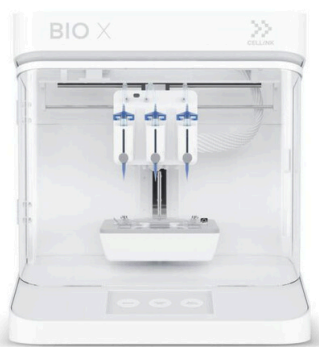
Bio x 3d BIOPRINTER
1. Advanced Functionality and Versatility
The BIO X's compatibility with virtually any material makes it the bioprinter of choice for industry leaders at the forefront of today's biggest scientific breakthroughs. Whether you are automating 3D cell cultures, developing complex tissue constructs, or testing new drug compounds, the BIO X 3D bioprinter has the advanced functionality and versatility to streamline workflows in a wide range of application areas.
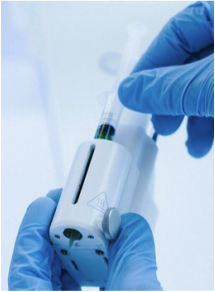
2. BIO X is the first 3D bioprinter in the world with Intelligent Printheads (iPH).
3. Patented Clean Chamber for better cell safety
Dual high-powered fans channel air through a HEPA H14 filter, designed to remove 99.995% of unwanted particles and microorganisms, and a part of the Clean Chamber™ technology, which also includes UV-C germicidal lights and rounded edges. Initiate Clean Chamber before beginning your experiment to ensure a cleaner environment in the chamber.
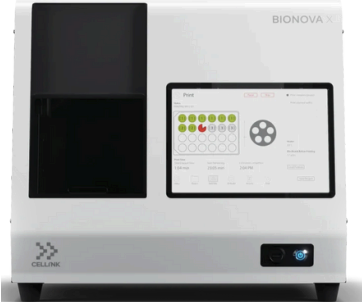
BIONOVA DLP 3D BIOPRINTER
1. Bringing Direct In-Well Printing to Light-based Bioprinting
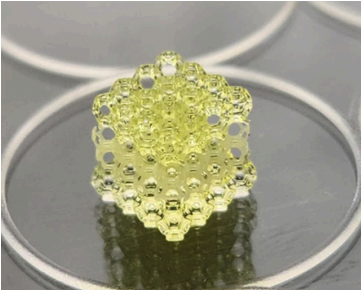
The cutting-edge BIONOVA X is a high throughput, high speed and high precision DLP 3D bioprinter, bringing light-based bioprinting to an entirely new level. By enabling multi-material bioprinting and multi-stiffness bioprinting, as well as live cell printing, users can recapitulate in vivo biomechanical properties with ease. The biofabrication of more accurate in vitro models enables greater results across the world of tissue engineering.
2. An open material platform designed for you
0 μm Printing Resolution
6 - 96 Multi-well plate Support*
RT - 60 °C Temperature Range
Print directly in 6-, 12-, 24- and 96- well plates
PRIMO
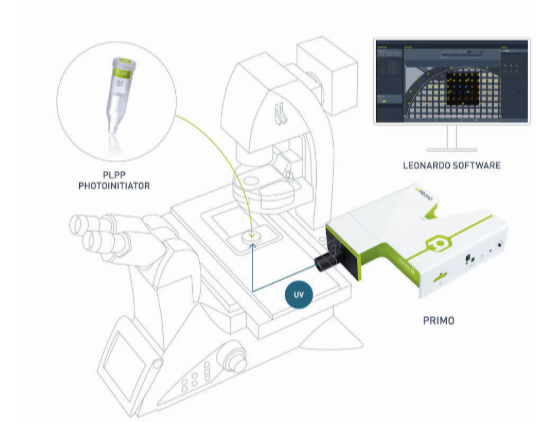
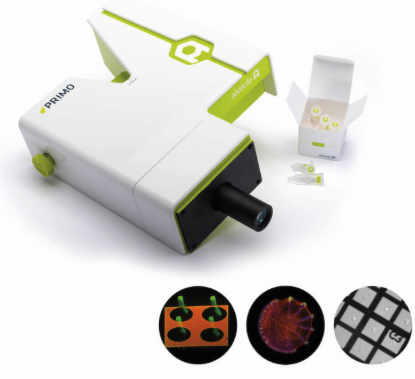
The PRIMO is a next-generation bioengineering system with a compact footprint and enhanced optical design that enables epi-fluorescence microscopy with faster performance. This single device combines micropatterning, hydrogel polymerization, and microfabrication to create custom in vitro cellular microenvironments for improved cell biology experiments and cryo-ET studies.
- Substrate Selection and Preparation
- Select appropriate substrate materials for your specific experimental needs
- Prepare substrates according to your experimental protocol requirements
- Ensure proper surface treatment for optimal cell adhesion and patterning
- Pattern Design and Software Upload
- Design custom micropatterns using the Leonardo software interface
- Upload your pattern designs to the PRIMO system.
- Configure parameters for micropatterning, microfabrication, or hydrogel polymerization
- UV Projection and Implementation
- Execute UV projection through the PRIMO DMD-based maskless photopatterning system
- Perform micropatterning, microfabrication, or hydrogel polymerization as designed
- Create custom in vitro conditions for enhanced cell experiments
The system enables researchers to study microenvironment influences on intracellular and intercellular mechanisms, providing better cell models for advanced biological research.
Workshops, Tech Talks, and Seminars
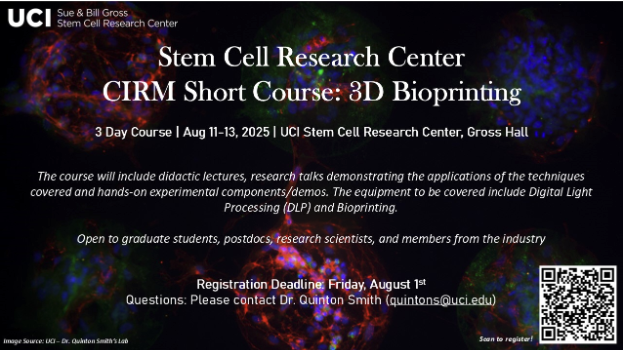
CIRM Short Course: 3D Bioprinting
(registration closed)
3 Day Course | Aug 11-13, 2025 | UCI School of Engineering (note location update)
The course will include didactic lectures, research talks demonstrating the applications of the techniques covered and hands-on experimental components/demos. The equipment to be covered include Digital Light Processing (DLP) and Bioprinting.
Open to graduate students, postdocs, research scientists, and members from the industry
Registration Deadline: Friday, August 1 st
Questions: Please contact Dr. Quinton Smith ( quintons@uci.edu)